
Rivers don’t run straight. They bend and curl, split around obstacles, pool up in slow eddies, and then drop into whitewater. Product launches work the same way. Nobody’s launch has gone in a clean line from kickoff to launch day (and if yours did, please tell me your secret).
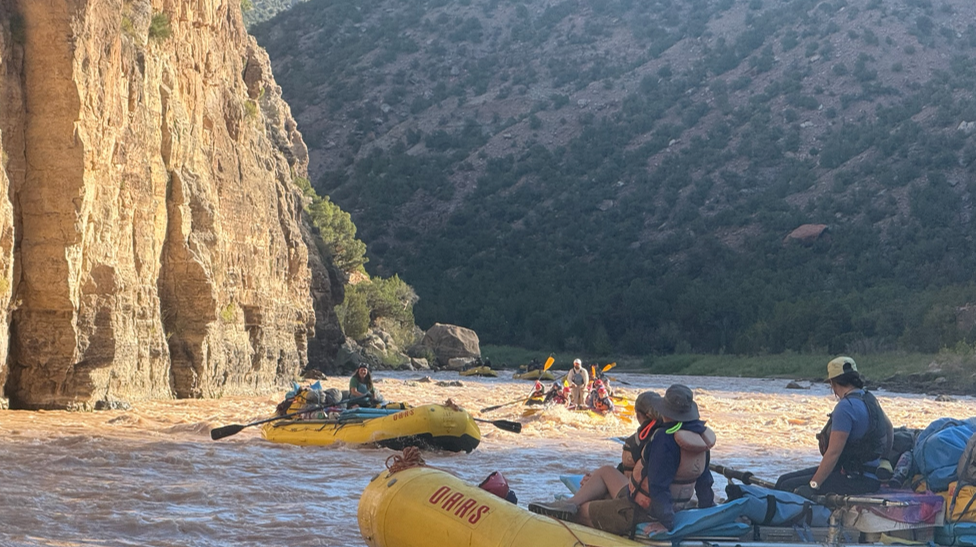
I was reminded of this on a recent rafting trip on the Green River in NW Colorado and NE Utah. Before we went anywhere near challenging rapids, our guides beached the fleet, walked us downstream, and had us stand on a rock looking at the water and talking about the conditions (flow, wind, level) for a solid ten minutes. Nobody touched a paddle as they explained what we would do and how it had changed from the last time they were there. They even threw in a few cautionary tales of rafting mishaps. That, it turns out, was the most important part of the run.

That’s the core analogy I used in the community talk I gave at Colorado Startup Week on September 17. Product launches are the yellow path above, not the idealized green one. And most product launches don’t fail on launch day. They fail weeks earlier in the journey, when the launch team skips the scouting and goes straight to a checklist of tactics.
Launches Are Big. So Where to Focus?
I only had an hour, so I focused on four primary areas that are most often skipped or underdeveloped: tested positioning, priority and ownership, sales and Customer Success (CS) alignment, and agreement on what success looks like.
Startups have it worse, and I tailored my talk to that profile. They don’t have a dedicated launch function (you’re the launch team, on top of your actual job), they launch constantly, and every launch sends a signal to their market, investors, and people about their level of competency and value.
I purposefully chose not to focus on the daily or weekly activities. Vendors (Atlassian, Amplitude, Crayon) and associations (PMA, Pragmatic Institute) publish plenty of how-to guides that get to the granular business of releases. I chose instead to cover four primary factors that can destabilize the entire process, each one paired with a light rafting analogy:
- Positioning: scout the rapid. Choose your line before you’re in the current. Positioning isn’t the feature list. It’s the value to the customer. Solicit feedback early and often from sales.
- Priority: know the class of water. Not every rapid needs the whole crew. A well-defined tiered approach will build consensus and facilitate tricky conversations on priorities.
- Alignment: brief the crew on shore. Sales and CS should hear the plan before the put-in, not halfway through the rapid. They likely talk with more customers than you do and may have better data than you (push back on subjective ideas, though).
- Measurement: eddy out and count heads. Agree on what “we made it” means before you shove off. You don’t need many metrics, but the ones you choose should be tied to the larger launch outcome(s).

A critical point: this isn’t a checklist you fill out once. It’s a process you run every trip, getting a little better each time.
The priority piece is where the metaphor works best. River rapids are graded Class I through V (our trip only peaked at IIIs). On Class I and II, you float and enjoy the scenery. On Class III to V, you scout, set safety, and put your strongest paddlers in the boat. Launches deserve the same honesty. A Tier 1 strategic launch (a new product, a new market, something worth press coverage) needs the full cross-functional crew and three or more months of lead time. A Tier 4 security patch needs a drawer statement for support and not much else.
The Shift from Launch Theory to Practice
My goal for this talk was to deliver practical advice (a playbook) to the audience of startup leaders, so I layered it with ideas and best practices from my peers and my own experience. Here are just a few.
Pro tips:
- Read your competitors’ positioning. If you sound just like them, you haven’t found your line yet.
- Skip the full RACI. On a small team, start with Responsible and Informed.
- Deliver enablement through meetings sales already attends, and schedule it well before the end of the month, quarter, or year.
- Benchmark your metrics for 3–4 months before launch. You’ll have something to compare against, and you’ll find out whether your data can be trusted.
Try this at work:
- Book three customer calls next week and ask them to describe the problem your release solves in their own words.
- Pull your next five launches and tier them out loud with the team in under 20 minutes.
- Invite sales and CS to your next launch kickoff. The kickoff, not the enablement meeting.
- Sit down with sales and marketing leadership, pick the 4–5 metrics that matter for your next launch, and work with BI, MarOps, and SalesOps on how to capture them.
I also included a few bonus lessons I’ve learned from 40+ launches, ones I couldn’t fit into the four-point framework above. These included:
- Hold a pre-mortem (your safety talk) five to six weeks before launch with every stakeholder in the room, and assign an owner to every risk.
- Separate your General Availability (GA) date from your public marketing launch day by a week or two, because code and operations will surprise you.
- Keep a central launch calendar as your river map, with milestones, handoffs, holidays, and the post-mortem on it.
- And settle pricing and packaging early. The downstream work (SKUs, sales calculators, asset updates) always takes longer than you expect, and sales and CS need time to settle into any new model.
If you want the full playbook PDF, including the tier tables, ownership grid, and metrics list, you can grab the slides here: CSW-product_launch_playbook-091726.
Ensure Success by Starting Early on the Launch Foundation
Back on the river, we made it through Upper and Lower Disaster Falls upright. It was easier than I thought it would be. That wasn’t talent or the luck of beginner rafters. It was the ten minutes we spent standing on a rock, taking in the conditions. It was the guides who clearly and consistently staked out their positioning, kept to their safety framework, communicated often, and considered every potential outcome – all earlier in the journey.
Launches that build real momentum are won the same way, weeks before launch day, at the start of the initiative. And when the next launch comes around, you run the same loop, starting again at scouting, carrying what the last stretch of river and the previous rafting trip taught you.
Chart your course. Plan for contingencies. Read the water. Then paddle.